

Ask civil engineers in Bangladesh who taught them concrete, and a remarkable number will name one teacher: Prof. Dr. M. Shamim Z. Bosunia. For forty years he taught at the Bangladesh University of Engineering and Technology (BUET). He helped write the country's first national building code, chaired the committees that set its standards for construction materials, led the national body of engineers, and served on the expert panels behind its largest bridges, tunnels and expressways. Well into his eighties, he still teaches.
This profile is written with respect, from public sources listed at the end. It is part of our series on the engineers and landmarks that shaped construction in Bangladesh.
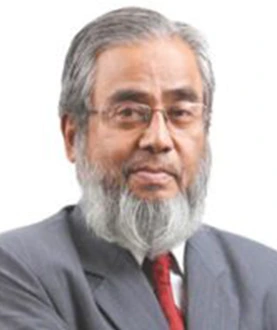
| At a glance | |
|---|---|
| Name | Prof. Dr. M. Shamim Z. Bosunia (in full, M. Shamimuzzaman Bosunia; also spelled Basunia) |
| Born | Nilphamari, then part of greater Rangpur; 31 January 1944 in official records (he has said November 1943) |
| Education | Dhaka College (1961); B.Sc. 1965 and M.Sc. 1972 in civil engineering, BUET; PhD 1979, University of Strathclyde, UK |
| Career | BUET, 1969–2009 (Professor from 1981); Emeritus Professor, University of Asia Pacific, Dhaka |
| Fields | Structural and concrete design, durability of concrete, repair and rehabilitation of structures, low-cost housing |
| Known for | BNBC 1993, BSTI material standards, IEB President 2013–14, Padma Bridge panel of experts |
Early life: from Nilphamari to Dhaka
Shamim Z. Bosunia was born in Nilphamari, in the north of present-day Bangladesh, at a time when it was part of greater Rangpur; his family's ancestral home lies near Patgram, close to the border. His university and institutional biographies record his date of birth as 31 January 1944. In a 2025 interview with Prothom Alo he explained that he was in fact born in November 1943, and that the later date is the one on his certificates, as was common for his generation.
His father was a magistrate who rose to senior posts in government administration, and the family moved with his postings. The young Shamim went to school in Mymensingh and then at Barisal Zilla School, where he studied from class seven to class ten. He passed his matriculation in 1959 and his intermediate examination at Dhaka College in 1961. He has recalled that when he spoke of becoming a teacher, his father told him that if he chose to teach, he would be a good one.
Education: concrete as Bangladesh really builds it
He studied civil engineering at the institution in Dhaka that grew from the old Ahsanullah Engineering College into today's BUET, and graduated in 1965. After a short spell with an American company, he returned to the university, joining the Department of Civil Engineering as a lecturer in 1969.
His research followed the materials and problems of his own country. His master's thesis, completed at BUET in 1972, studied the torsional behaviour of plain and reinforced beams of brick aggregate concrete. Because natural stone is scarce in much of Bangladesh, broken brick (khoa) has long been used in concrete, and engineers needed to know how such concrete behaves when a beam is twisted as well as bent.
A Commonwealth Scholarship then took him to the University of Strathclyde in Glasgow, where he completed his PhD in 1979 on the deterioration of Portland cement paste exposed to sodium chloride environments: in plain words, how salt attacks concrete. For a country with a long coastline and saline soil and water in the south, that question remains as important today as it was then. See how corrosion damages concrete.
Forty years at BUET
He became Professor of Civil Engineering in 1981 and, over the following years, served the university in many roles:
- Head of the Department of Civil Engineering, 1985–87
- Dean of the Faculty of Civil Engineering, 1990–92
- Director of Students' Welfare, 1997–99
- Provost of a residential hall, and adviser to sports and games
Generations of students remember his classes. BUET's own biography of him speaks of an outstanding wit and humour that never came at the expense of substance, and describes him as a pioneering academic in promoting modern concrete construction in Bangladesh. He published more than thirty journal papers and research articles, and served on the faculty selection boards of DUET, CUET, KUET and RUET, the country's other public engineering universities.
He retired from BUET in 2009 and became Emeritus Professor in the Department of Civil Engineering at the University of Asia Pacific (UAP) in Dhaka. According to Prothom Alo's 2025 profile, he has taught there for about twenty-five years without taking a salary.
Shaping the building code and national standards
When Bangladesh produced its first national building code in 1993, Prof. Bosunia made a significant contribution, particularly to the parts on building materials, the design of concrete and ferrocement, and the evaluation of existing buildings. That last subject, how to judge whether an existing building is safe, is the foundation of every structural assessment carried out in the country today.
He also chaired the civil engineering committees of the Bangladesh Standards and Testing Institution (BSTI), helping to set the national standards for construction materials, and served on the board of governors of the Housing and Building Research Institute (HBRI).
An engineer in practice
Alongside teaching, he has worked for about four decades as a consulting engineer, as team leader or team member, on projects across the country. Those named in his biographies and interviews include:
- the design of the Mirpur Indoor Stadium and of high-rise buildings, among them the 39-storey City Centre in Dhaka;
- special concrete for the research reactor facility of the Bangladesh Atomic Energy Commission at Savar;
- the East-West Interconnector transmission line across the Jamuna;
- a 500-bed hospital in Bogura;
- the repair and rehabilitation of hundreds of coastal cyclone shelters, and a master plan for cyclone shelters;
- the repair and strengthening of the Bangabandhu National Stadium and the Mirpur cricket stadium; and
- a number of bridges for the Roads and Highways Department.
Several of these are repair and strengthening projects. Long before structural retrofitting became a regular demand in Bangladesh, he was applying his research on concrete durability to keeping public buildings safely in service.
The Padma Bridge and other national projects
The Government of Bangladesh appointed him to the panel of experts for the Padma Multipurpose Bridge, where he served alongside his own teacher, Prof. Jamilur Reza Choudhury. After Prof. Choudhury's death, he took over as head of the panel. He has also served on the expert panels for the Karnaphuli Tunnel in Chattogram, the first section of the Dhaka Metro Rail and the Dhaka Elevated Expressway. Prothom Alo's 2025 profile notes that he takes no fee for this work.
In a June 2022 interview with Prothom Alo, as the Padma Bridge opened, he explained some of the decisions behind it. Because of the difficult river-bed soil, the number of piles under each pier was increased from six to seven, and the ground around the piles was strengthened by skin grouting. He said bridges of this kind are designed for a life of 60 to 70 years in theory, but that the Padma Bridge could last more than a hundred, with maintenance as the deciding factor.
Leading the engineering profession
The country's engineers elected him President of the Institution of Engineers, Bangladesh (IEB) for the 2013–14 term. He has also served as President of the Bangladesh Association of Consulting Engineers (BACE), as chairman of the board of the Rajshahi Water Supply and Sewerage Authority (WASA), as an independent director of Prime Bank Limited, and as a member of the academic advisory council of North South University.
Beyond engineering: a life in football
His service reached well beyond engineering. From 1986 to 2002 he served the Bangladesh Football Federation as a member, treasurer and later vice-president, and he was team leader of the national football team on tours to the Maldives (1996), Qatar (1998) and the United Kingdom (2000). He also represented Bangladesh as a special observer at the 1990 Asian Games in Beijing and the 1991 Winter Universiade in Japan.
His message on earthquakes and safe building
In his 2025 interview with Prothom Alo, Prof. Bosunia spoke with concern about Dhaka's vulnerability to a strong earthquake. He warned that a very large share of the city's buildings are at risk, argued that no building should be constructed without a soil test, and pointed out that concrete on many sites is still made by guesswork rather than by measured mix design, a failing for which he said engineers, too, must take responsibility. He called for a culture of earthquake-resistant construction to be built now, not after a disaster.
Each of these points is practical advice for building owners. See why a soil test comes first, how concrete strength is controlled and how to tell whether a building is earthquake-safe.
A life of service, and what it teaches
Asked why he gave up the chance to settle abroad, he answered with a question that sums up a lifetime spent building his own country: What better place is there than one's own country?
(Prothom Alo, September 2025).
For engineers and building owners, his career carries lessons that are as practical as they are inspiring:
- Start from local materials and local conditions. His research began with the concrete Bangladesh actually uses, brick aggregate, and the threat it actually faces, salt.
- Existing buildings matter. He was evaluating and repairing existing structures decades ago. Most of the country's buildings already stand; keeping them safe is as important as designing new ones.
- Standards protect people. Codes and material standards turn knowledge into rules every builder must follow.
- Maintenance is part of design. A structure looked after properly can serve far beyond its design life.
- Teaching is service. Thousands of engineers carry his lessons onto building sites across the country every day.
At Prime Base Engineering, we are among the many engineers who build on the foundations he helped lay.
Sources
- Prof. Dr. M. Shamim Z. Bosunia, Department of Civil Engineering, BUET (biography compiled by Dr. K. M. Amanat)
- Success Story of Prof. Dr. M. Shamim Z. Bosunia, Institution of Engineers, Bangladesh
- Prof. Dr. Engr. Shamim Z. Basunia, Board of Accreditation for Engineering and Technical Education (BAETE)
- Anwar Hossain, interview on the Padma Bridge, Prothom Alo, 25 June 2022
- Anisul Haque, interview "Almost all buildings in Dhaka are at earthquake risk", Prothom Alo, 1 September 2025
- Anisul Haque, profile "A brilliant engineer, a lively person", Prothom Alo, 22 September 2025
Topics:Shamim Z. BosuniaShamimuzzaman BosuniaBUETPadma BridgeInstitution of Engineers BangladeshBNBCstructural engineering
Frequently asked questions
Who is Prof. Dr. Shamim Z. Bosunia?
Prof. Dr. M. Shamim Z. Bosunia is a Bangladeshi structural engineer and teacher. He taught civil engineering at BUET from 1969 to 2009, contributed to the first Bangladesh National Building Code in 1993, was President of the Institution of Engineers, Bangladesh, for 2013–14, and served on the government's expert panels for the Padma Bridge and the Karnaphuli Tunnel. He is Emeritus Professor at the University of Asia Pacific, Dhaka.
What is his full name, and how is it spelled?
Prothom Alo writes his name in full as M. Shamimuzzaman Bosunia (এম শামীমুজ্জামান বসুনিয়া). He is widely known as Shamim Z. Bosunia (শামীম জেড বসুনিয়া). BUET and the Institution of Engineers spell the surname Bosunia; BAETE's profile also uses Basunia.
What was his role in the Padma Bridge?
He was a member of the government-appointed panel of experts for the Padma Multipurpose Bridge. After the death of Prof. Jamilur Reza Choudhury, who had been his own teacher, he took over as head of the panel, as reported by Prothom Alo in June 2022.
Where did he study?
He went to school in Mymensingh and at Barisal Zilla School, took his intermediate examination at Dhaka College in 1961, earned his B.Sc. (1965) and M.Sc. (1972) in civil engineering at BUET, and completed his PhD in 1979 at the University of Strathclyde in Glasgow, on a Commonwealth Scholarship.
What did he research?
Concrete as Bangladesh actually uses it. His master's thesis studied the torsional behaviour of beams made with brick aggregate concrete, and his PhD studied how Portland cement paste deteriorates in salt (sodium chloride) environments. His fields include concrete durability, repair and rehabilitation of structures, and low-cost and rural housing.
About Muhammad Sarowar Hossain
Founder & CEO, Prime Base Engineering, B.Sc. in Civil Engineering, PGDSCM-ISCEA. Muhammad Sarowar Hossain founded Prime Base Engineering and leads its structural assessment, retrofitting and construction work. He has worked on structural retrofitting of factories and industrial buildings across Bangladesh since 2017.
One email a month with new articles
Assessment, retrofitting and construction guidance. Unsubscribe at any time.