
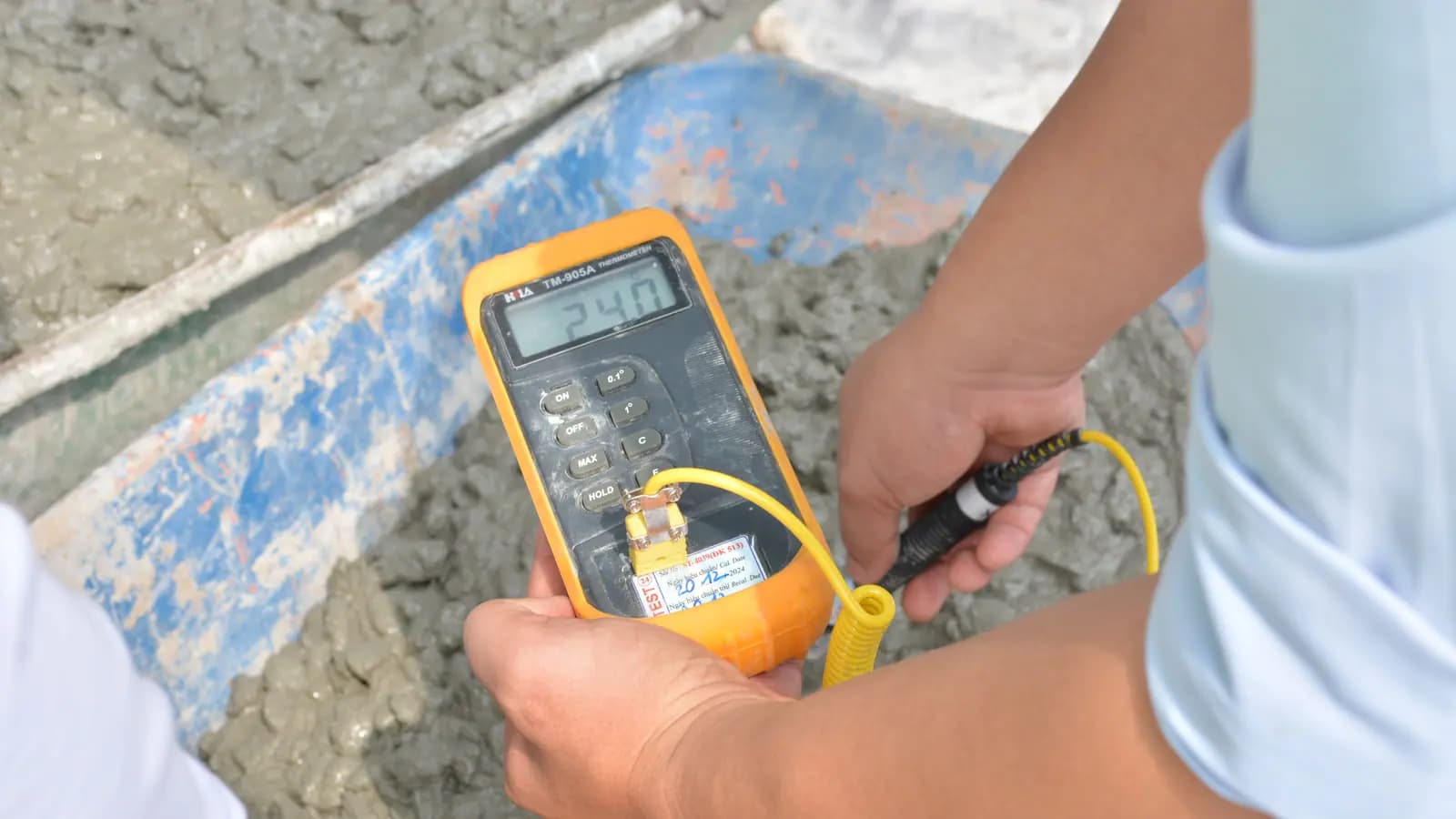
Concrete tests tell engineers what is really inside a building: how strong the concrete is, where the reinforcement sits and whether the steel is corroding. They are the backbone of any Detailed Engineering Assessment or structural audit. Owners planning an assessment often want to know what the testing alone will cost.
Below are our standard 2026 prices, a guide to what each test tells you, and a sample budget for a typical building. Prices include 15% VAT.
Prices
Testing price list
| Test | Unit | Price (Tk) |
|---|---|---|
| Concrete strength | ||
| In-situ concrete core with scanning first (avoids rebar) | per core, min. 3 | 19,000 |
| In-situ concrete core: cutting and testing | per core, min. 3 | 9,300 |
| Core supplied to the laboratory | per core | 4,400 |
| Concrete cylinders 150 x 300 mm | set of 3 | 6,000 |
| Concrete cylinders 100 x 200 mm | set of 3 | 3,300 |
| Concrete cubes under 200 mm | set of 3 | 5,000 |
| Concrete cubes 200 to 300 mm | set of 3 | 6,000 |
| Concrete beam in flexure | set of 3 | 13,200 |
| Concrete mix design, without admixture | per design | 97,900 |
| Concrete mix design, with admixture | per design | 1,08,400 |
| Non-destructive tests on site | ||
| Ferro-scan (rebar location, spacing and cover) | per location, 2 scans | 18,500 |
| Rebound (Schmidt) hammer test | per location, min. 3 | 9,300 |
| Windsor probe (penetration) test | per location, min. 3 | 8,600 |
| Reinforcing steel and structural steel | ||
| Rebar tensile test up to 25 mm (with weight and elongation) | set of 3 | 3,300 |
| Rebar tensile test, above 25 mm up to 32 mm | set of 3 | 4,900 |
| Rebar tensile test, above 32 mm up to 50 mm | set of 3 | 6,000 |
| Rebar bend test, up to 25 mm | set of 3 | 1,600 |
| Rebar re-bend test, up to 25 mm | set of 3 | 2,200 |
| Mechanical coupler tension test | set of 3 | 9,900 |
| Bolt tension test, up to 25 mm | set of 3 | 5,300 |
| Anchor bolt tension test, up to 25 mm | set of 3 | 7,700 |
| Steel plate or angle tension test, up to 16 mm | set of 3 | 6,900 |
| Butt-welded joint test | per sample | 10,700 |
| Cement | ||
| Compressive strength at 3, 7 and 28 days (ASTM) | per sample | 16,400 |
| Compressive strength at 2 and 28 days (EN) | per sample | 39,700 |
| Fineness with density | per sample | 10,600 |
| Initial and final setting time | per sample | 6,900 |
| Normal consistency | per sample | 4,200 |
| Soundness | per sample | 15,900 |
| Sand, stone and brick chips | ||
| Sample preparation (charged once per sample) | per sample | 2,600 |
| Sand: sieve analysis and fineness modulus (FM) | per sample | 5,600 |
| Silt or fine content (finer than No. 200) | per sample | 5,600 |
| Coarse aggregate: sieve analysis and gradation | per sample | 9,900 |
| Aggregate crushing value (ACV) | per sample | 11,200 |
| Aggregate impact value (AIV) | per sample | 9,800 |
| Los Angeles abrasion | per sample | 11,200 |
| Specific gravity and absorption | per sample | 9,900 |
| Unit weight of coarse aggregate | per sample | 7,300 |
| Flakiness index | per sample | 11,600 |
| Elongation index | per sample | 12,700 |
| Organic impurities, salt or sulphate | per sample | 6,600 |
| Bricks and blocks | ||
| Brick crushing strength (ASTM) | set of 5 | 7,300 |
| Brick water absorption (ASTM) | set of 5 | 3,300 |
| Brick size and shape | set of 5 | 6,600 |
| Brick unit weight | set of 5 | 5,700 |
| Efflorescence | set of 5 | 7,300 |
| Hollow block or paving block compressive strength | set of 3 | 5,300 |
| Soil investigation and laboratory soil tests | ||
| Soil boring with SPT and standard tests, up to 20 m (inside Dhaka) | per borehole, min. 3 | 1,05,800 |
| Soil boring with SPT and standard tests, up to 25 m (inside Dhaka) | per borehole, min. 3 | 1,32,300 |
| Soil boring with SPT and standard tests, up to 30 m (inside Dhaka) | per borehole, min. 3 | 1,78,500 |
| Atterberg limits (liquid and plastic limit) | per sample | 6,600 |
| Grain size: sieve and hydrometer | per sample | 9,300 |
| Unconfined compression test | per sample | 13,200 |
| One-dimensional consolidation | per sample | 31,700 |
| Triaxial test, unconsolidated undrained (UU) | per sample | 31,700 |
| Standard Proctor compaction | per sample | 19,800 |
| Modified Proctor compaction | per sample | 26,500 |
| Laboratory CBR | per sample | 39,700 |
| Load tests and field tests | ||
| Plate load test | per location | 1,28,300 |
| Static pile load test (axial capacity) | per pile, min. Tk 1.35 lakh in Dhaka | 1,41,500 |
| Pile integrity test (PIT) | per pile, min. Tk 75,000 in Dhaka | 4,000 |
| Field CBR | per location | 52,900 |
| Field density (sand cone) | per spot | 10,600 |
| Site visit for field tests | ||
| Inside Dhaka city | per visit | 26,500 |
| Nearby districts (Gazipur, Narayanganj, Savar and similar) | per visit | 52,900 |
| Distant districts (same-day return) | per visit | 79,400 |
Priced on request: Ultrasonic pulse velocity (UPV), Half-cell potential (corrosion mapping), Carbonation depth, Chloride content.
Prices in Taka, including 15% VAT. Valid for 2026; a written quote confirms the number of tests, locations and site visits for your building.
What each test tells you
| Test | What it measures | When it is used |
|---|---|---|
| Concrete core | True compressive strength of the concrete in place | Every assessment; also calibrates the faster tests |
| Rebound hammer | Surface hardness, a guide to relative strength | Many locations quickly, to find weak zones |
| Ferro-scan | Position, spacing and cover of reinforcement | Checking drawings, or finding the steel when there are none |
| Cylinders and cubes | Strength of concrete as cast | Quality control on new construction |
| Rebar tensile test | Yield strength, tensile strength, elongation | Checking the grade of steel used |
| Soil boring | Soil layers, strength and water table | New foundations, extra floors, settlement problems |
More detail in reading core test results, rebound hammer and UPV tests and our overview of NDT for concrete buildings.
Three tests, one column: what you pay for
A column cut open to show what each test sees, and a sample plan for a five-storey building.
A sample testing budget
An illustration for a five-storey RCC building in Dhaka. The real plan depends on the building and is set by the engineer.
| Item | Quantity | Approximate cost (Tk) |
|---|---|---|
| Core with scanning first | 10 (2 per floor) | 190,000 |
| Rebound hammer locations | 15 (3 per floor) | 139,500 |
| Ferro-scan locations | 10 (2 per floor) | 185,000 |
| Rebar tensile tests | 2 sets | 6,600 |
| Site visits inside Dhaka | 2 | 53,000 |
| Total | about 5.7 lakh |
When testing is part of a full Detailed Engineering Assessment, the testing plan is usually included in the DEA fee, so check what a DEA quote covers before budgeting for tests separately.
How to keep testing costs down
- Group the field work. Every site visit is charged, so plan all cores, scans and hammer tests for one or two visits.
- Share the drawings. Good drawings reduce the scanning needed to find the reinforcement.
- Test smart, not less. Fast tests across the building plus a few well-placed cores give a reliable picture at the lowest cost.
Testing is not the whole assessment
Test results are raw data. They become useful only when an engineer feeds them into an analysis of the whole structure and checks every member against BNBC 2020. That is the difference between a test report and a Detailed Engineering Assessment.
Need a testing plan?
Tell us the building's size, number of floors and use. We will set out which tests are needed, how many and where, with a written quote. Ask for a testing plan.
Topics:concrete testingcore testrebound hammerNDTcost
Frequently asked questions
How much does a concrete core test cost in Bangladesh?
Prices for an in-situ core, cut and tested, are in the table in this article, including VAT. A core with scanning first costs about twice as much, and each site visit is charged separately.
How much does a rebound hammer test cost?
It is priced per location, with at least three readings at each, plus the site visit. See the price table in this article.
Why do I need cores if rebound hammer tests are cheaper?
Rebound hammer readings only measure surface hardness and can be misleading on their own. A few cores give the true strength and are used to calibrate the faster tests across the whole building.
Are these prices fixed?
They are our standard 2026 prices. The written quote for your building confirms the number of tests, locations and site visits.
How many tests does a building need?
It depends on its size, number of floors and how uniform the concrete is. A testing plan sets out cores, rebound hammer and scanning locations for each floor and element type before work starts.
About Muhammad Sarowar Hossain
Founder & CEO, Prime Base Engineering, B.Sc. in Civil Engineering, PGDSCM-ISCEA. Muhammad Sarowar Hossain founded Prime Base Engineering and leads its structural assessment, retrofitting and construction work. He has worked on structural retrofitting of factories and industrial buildings across Bangladesh since 2017.
One email a month with new articles
Assessment, retrofitting and construction guidance. Unsubscribe at any time.